Fatima & Hassan | Outdoor Walima Shoot | Couple Walima Shoot | Walima Shoot By Hamza’s Production



Where elegance meets emotion, every frame tells a story of love, grace, and timeless moments. From the first glance to every step they took together, this is not just a wedding shoot. It is a memory crafted to last forever.
At Hamza’s Production, the team does not simply capture events. They create experiences that couples can relive for a lifetime. This cinematic Walima couple shoot, set across the open grounds of a horse farm on a clear, bright day, is one of the most visually striking collections in their wedding photography portfolio. Five frames. One white horse. A bride in silver and sage. A groom in a sharp dark suit. And a series of images that together tell a complete and emotionally resonant story of a couple at the beginning of their life together.
About This Walima Couple Shoot
The Walima is the formal reception that follows the Nikah in a Pakistani wedding, and it carries with it a different visual character from the Mehndi and the Barat. Where the Mehndi is warm, informal, and celebratory, and the Barat is grand and ceremonially significant, the Walima is often the day when a couple appears most relaxed and most fully themselves. The formality of the wedding sequence is nearly complete. The pressure of the Barat day has passed. There is a lightness and ease that the Walima day carries, and that ease is visible throughout this shoot.
The decision to set this Walima couple shoot on the open grounds of a horse farm, with riding tracks, stable buildings, garden pathways, and a white horse as a compositional element, reflects the kind of creative location thinking that defines Hamza’s Production’s approach to every wedding photography commission they undertake.
The five frames produced from this session cover a complete visual arc from intimate close portrait work to wide, architectural outdoor compositions, giving the couple a final Walima image set that is as varied and visually rich as any collection from across their entire wedding sequence.
According to Brides Magazine, outdoor Walima photography at distinctive natural or agricultural locations is among the most searched and saved categories of Pakistani wedding photography today, as couples increasingly seek settings that reflect their personal character rather than defaulting to generic venue backdrops.
The Look: Silver, Sage, and Modern Grace
The bridal outfit in this series is a full-length anarkali lehenga in a soft sage green and silver combination, covered in intricate silver embroidery and mirror work that catches daylight beautifully across every frame. The silhouette is full and voluminous, with a wide skirt that spreads dramatically when the bride moves or turns, which the fifth frame of this series captures at its most spectacular. The matching dupatta is worn as a light veil over the head, its silver border catching the outdoor light.
The jewelry is elegantly restrained for a Walima outfit. A silver and dark stone choker sits at the throat. Drop earrings frame the face. A simple maang tikka sits at the center parting. The combination is sophisticated and modern, complementing the contemporary elegance of the outfit without competing with its embroidery detail.
The groom wears a well-tailored dark navy suit with a white dress shirt and a dark tie, a classic and clean combination that reads as modern and formally handsome without the traditional embroidery of a Barat sherwani. The contrast between his dark suit and her light silver and sage creates a visual balance in every frame that is sharp, contemporary, and consistently pleasing across all the different compositions and backgrounds of the shoot.
Vogue Weddings identifies the silver and sage green bridal palette as one of the most photographically versatile options for outdoor Walima shoots, particularly in daylight conditions, where the cool silver tones of the embroidery reflect the available light and give the outfit a natural luminosity that richer, darker bridal colors do not always achieve in bright outdoor settings.
Frame 1: The First Glance
The opening frame of this series is an intimate close portrait, tighter in its framing than any of the subsequent images. The bride stands with her head slightly bowed, her eyes downward, her henna-covered hand raised near her face. The groom leans in close from her right, his gaze directed downward toward her with a focused, quiet intensity. Their faces are close but not touching. The moment is suspended, somewhere between a look and a whisper.
The background is open and slightly out of focus, with the sandy track and white fencing of the horse farm visible behind them. The soft outdoor light of a clear day falls evenly across both faces, catching the silver embroidery of the bride’s dupatta and the detail of the henna on her raised hand.
This is the frame that establishes the emotional tone of the entire series. It tells the viewer, before any of the wider and more dramatic compositions are seen, that this shoot is about two real people with a genuine connection, and that every subsequent image will be grounded in that connection regardless of how cinematic or visually ambitious the compositions become.
This approach to opening a wedding photo series with an intimate emotional portrait before expanding to wider settings is a signature of Hamza’s Production’s wedding photography approach, rooted in storytelling principles that build from the personal outward to the contextual.
Frame 2: Together Beside the White Horse
The second frame introduces the white horse that becomes a recurring visual element through the middle of the series. The couple stands close together in the foreground, the bride resting her hand on the groom’s chest, both leaning slightly toward each other with their foreheads nearly touching. The white horse stands directly beside them in the right side of the frame, its large head occupying the foreground and creating a natural compositional boundary that draws the eye toward the couple.
The sandy track of the horse farm and the green trees beyond the fence provide the background. The horse’s white coat catches the daylight in the same way that the bride’s silver embroidery does, creating a visual unity between the two white and silver tones in the frame that makes the composition feel considered and intentional rather than accidental.
The horse’s presence in this frame is not decorative. It is structural. It creates scale, visual interest, and a sense of the outdoor environment that adds enormously to the cinematic quality of the image. Without the horse, this would be a beautiful couple portrait. With the horse, it becomes something more unusual and more memorable.
According to the Professional Photographers of America, incorporating living animals into wedding portrait photography requires significant preparation and skill from the photography team, but when executed well it produces images with a unique visual character that standard portrait settings cannot replicate.
Frame 3: Walking the Grounds
The third frame pulls back to a wider composition, showing the couple walking together along a pathway within the farm grounds, the white horse walking between them. The bride holds the horse gently by the neck on her side, smiling. The groom leads from his side. Between them the white horse walks calmly, its full body visible and in focus alongside both figures.
The background in this frame shows more of the farm environment, with a white arched gateway visible behind the group, green trees and garden planting visible beyond the fence, and the open pathway stretching ahead. The natural daylight is bright and even, giving the image a clean, fresh quality that is completely different from the more intimate lighting of the earlier frames.
The composition here is deliberately lighthearted. The bride is smiling broadly. The groom walks with relaxed, easy confidence. The horse moves peacefully between them. The image communicates something important about this couple on this day, that alongside all the formal ceremony and visual grandeur of a wedding sequence, there is genuine joy, ease, and happiness, and that those qualities are as worth documenting as the most elegantly composed architectural portrait.
For couples who want aerial perspectives of outdoor locations like this horse farm, Hamza’s Production’s drone photography and videography service adds a further dimension to outdoor wedding coverage that ground-level photography cannot achieve.
Frame 4: Standing at the Stable Gate
The fourth frame uses the physical structure of the stable environment as its compositional anchor. The couple stands at or near a low stable gate, the bride resting her arms on the top of the weathered white gate, the groom standing close beside and slightly behind her. Between them and slightly behind, the white horse stands in the yard with its head turned toward the camera, adding a third figure to the composition that gives it an unexpected playful quality.
The background shows the horse farm track and a row of tall, slim poplar trees that create a distinctive vertical pattern across the upper part of the frame. The trees are in full leaf, their soft green providing a natural backdrop that connects visually with the sage tones of the bridal outfit.
Both the bride and groom face away from each other slightly, both looking toward the camera with a calm, composed presence. The weathered texture of the stable gate in the foreground adds a rustic, organic detail that grounds the image in the specific character of this location. It is not a polished studio surface or a perfectly painted venue wall. It is a real working stable gate, and its imperfection makes the frame feel more honest and more interesting than a more conventionally beautiful background would.
Frame 5: The Lehenga Twirl on the Garden Steps
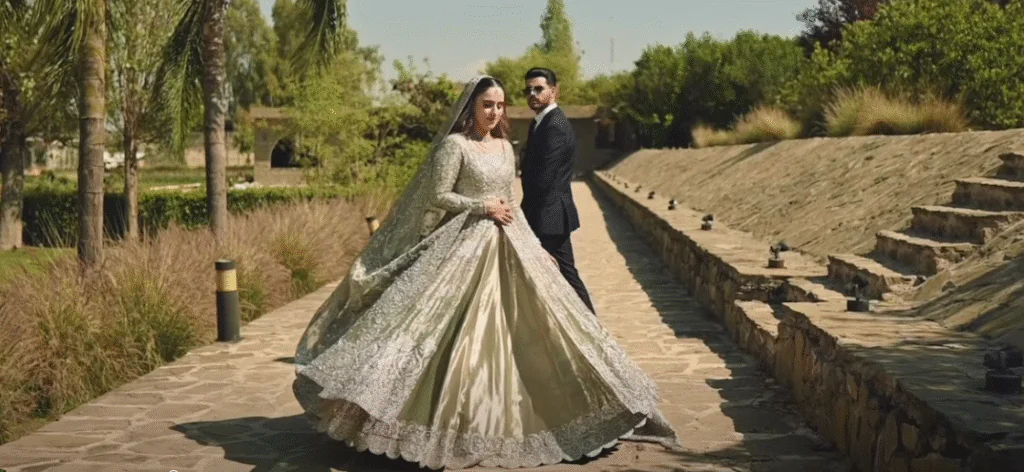
The fifth and final frame of this series is its most visually spectacular, and it brings the collection to a conclusion that is both aesthetically triumphant and emotionally satisfying. The bride stands on a stone pathway bordered by a long staircase structure descending to the left, her full lehenga spread out around her in a wide, dramatic circle as she turns. The embroidered border of the lehenga skirt, visible in its full circumference, creates a perfect silver ring of fabric around her.
The groom stands directly behind her, turned slightly away and looking to his left, creating a visual separation between the two that allows the bride and her spinning lehenga to fully command the frame while his presence in the background anchors the image with a sense of narrative connection.
The environment in this frame is the richest and most varied of the series. The stone pathway. The stepped stone wall descending to the right. Palm trees. Garden planting. Green trees in the background. The whole outdoor setting of the farm visible in its full depth and variety behind the couple. And at the center of all of it, the bride in her silver and sage lehenga, turning, the fabric lifting and spreading in a perfect circle that the camera has caught at exactly the right moment.
This is the image that couples share. It is the frame that appears in portfolios and on social media feeds and that makes other couples want to book a shoot that produces moments like this one. It is technically demanding, requiring precise timing to catch the lehenga at the peak of its spread, and visually rewarding in a way that few other wedding photography compositions can match.
For couples who want their images from shoots like this one preserved in a beautifully designed physical format, Hamza’s Production’s album design and print service transforms collections like this five-frame Walima series into professionally designed and printed wedding albums built to last across generations.
Why an Outdoor Walima Shoot Creates Photographs That Last Forever
The decision to take a Walima couple shoot outdoors, and specifically to use a distinctive natural environment like a horse farm rather than a standard garden or park, makes a fundamental difference to the quality and character of the images produced.
Outdoor natural light, particularly the bright, clear daylight of a mid-morning or late morning session, gives every frame a freshness and depth that indoor photography rarely achieves. Colors read more accurately. Skin tones are more natural. The embroidery and texture of the bridal outfit are rendered with greater clarity and detail. And the sense of space created by an outdoor environment, with sky, trees, and open ground visible in the background, gives the couple room to breathe and move within the frame in a way that indoor settings do not allow.
The specific character of the horse farm location in this series adds a further layer of visual distinctiveness. The combination of sandy tracks, white fencing, stable buildings, garden pathways, stone steps, and tall trees creates a setting with multiple compositional environments that can be used for very different types of images within a single session, which is exactly what this five-frame series demonstrates.
What the White Horse Brings to a Cinematic Wedding Shoot
The white horse that appears in three of the five frames in this series is not simply a prop. It is a compositional element that changes the character of every image it appears in and gives the series a visual signature that makes it immediately distinctive from any other outdoor Walima shoot.
In the second frame, the horse creates intimacy by framing the couple within its body beside them. In the third frame, the horse becomes a playful, warm presence walking between the couple on either side. In the fourth frame, the horse appears as a background figure that adds a sense of the environment’s living character without dominating the composition. In each case the horse contributes something different, and in each case the contribution elevates the image beyond what it would have been without that element present.
Working with a live animal on a wedding shoot requires coordination, patience, and the kind of calm, efficient direction that comes from significant experience working in outdoor environments with unpredictable elements. Hamza’s Production’s modeling shoots experience with diverse and challenging outdoor locations has built exactly the kind of practical outdoor photography expertise that makes sessions like this one possible and successful.
How Hamza’s Production Plans an Outdoor Walima Session
Every outdoor Walima couple shoot that Hamza’s Production undertakes begins with a location assessment. For a session at a distinctive environment like a horse farm, this means visiting the location in advance to identify the strongest compositional settings, understand how the light falls at different times of day, plan the sequence of shooting positions that will give the final image set visual variety and narrative arc, and coordinate with the location management regarding any specific requirements or restrictions.
The decision about what time of day to schedule the session is critical for outdoor photography. Bright midday light, as seen in most frames of this series, produces clean, even illumination that is ideal for capturing the full detail of embroidered bridal outfits. Earlier morning or late afternoon golden hour light would produce a warmer, more romantic quality in the images. The choice depends on the specific visual outcome the couple and the photography team are working toward.
The post-production work applied to this series maintains the clean, fresh brightness of the outdoor daylight while adding a subtle warmth and depth to the skin tones and the silver and sage tones of the bridal outfit that gives the images their finished, polished quality without departing from the natural character of the outdoor light.
Every Frame Is a Memory Crafted to Last
At Hamza’s Production, the guiding principle behind every wedding photoshoot is that a photograph is not a record of an event. It is a memory. It is the thing that allows a couple to step back into a moment that has passed and feel it again with the same warmth and clarity they felt on the day itself.
Every frame in this Walima couple shoot has been created with that principle in mind. The close intimate portrait of the first glance. The quiet connection of two people and a white horse in the second frame. The natural, joyful energy of the couple walking with the horse between them in the third. The composed, honest portrait at the stable gate in the fourth. And the spectacular, cinematic lehenga twirl that brings the series to its visual peak in the fifth.
Together these five frames are not just a record of a Walima day. They are a story about two people, told through images that are beautiful enough to look at for a lifetime and true enough to feel the same way they felt on the day they were made.
Book Your Walima Couple Shoot with Hamza’s Production
Hamza’s Production has over 15 years of experience capturing Walima celebrations, outdoor couple sessions, and cinematic wedding photoshoots across Islamabad, Lahore, Karachi, and Dubai. Their team brings creative location thinking, technical precision, and genuine care for the couples they work with to every session they undertake.
The five frames in this portfolio represent the quality and creative ambition you can expect from a Walima couple shoot booking with Hamza’s Production. Every location is chosen for its visual potential. Every composition is planned and considered. Every moment, including the unexpected and unplanned ones, is watched for and captured with skill and care. And every finished image is delivered to the highest professional standard.
To book your own cinematic Walima couple shoot, outdoor wedding photoshoot, or complete multi-day wedding photography and videography package, visit Hamza’s Production and get in touch with the team to discuss your vision for your most important day.